
Last updated October 16, 2026
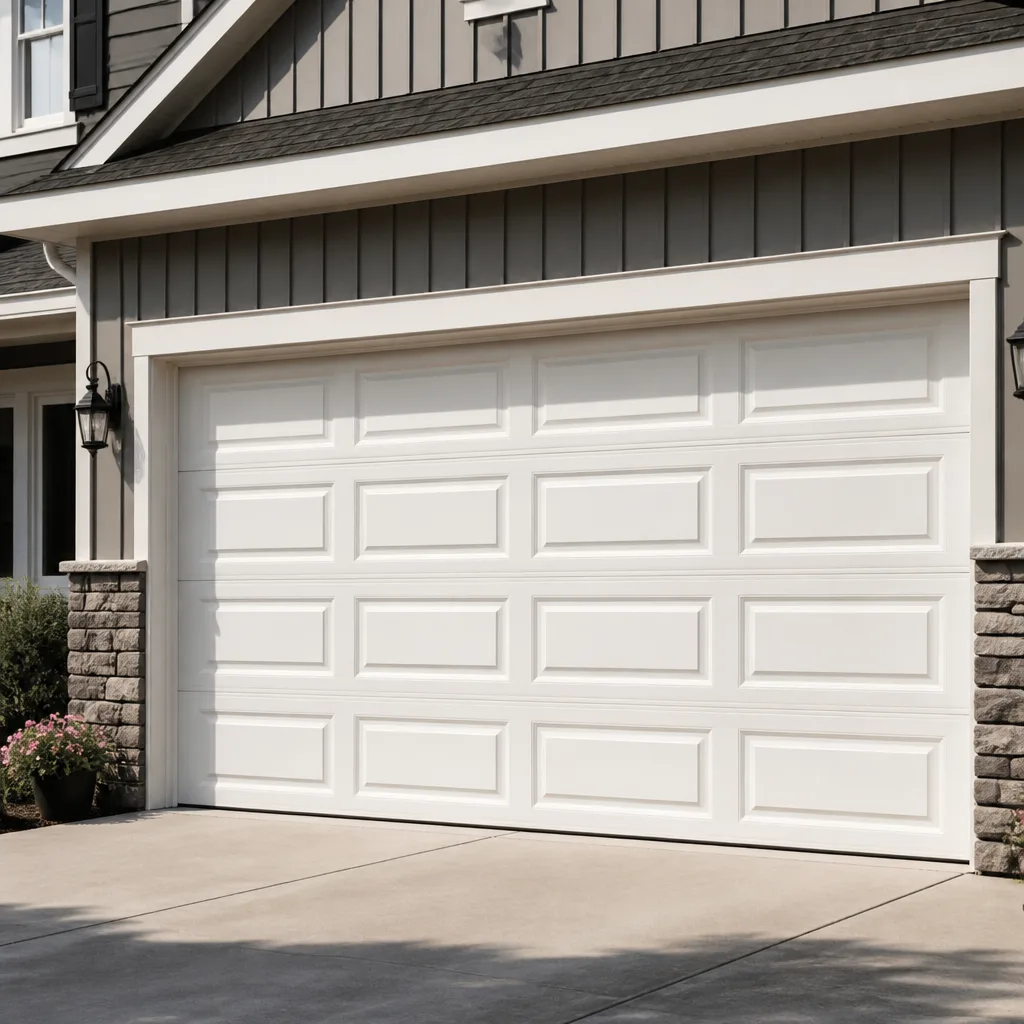 Raised-panel steel
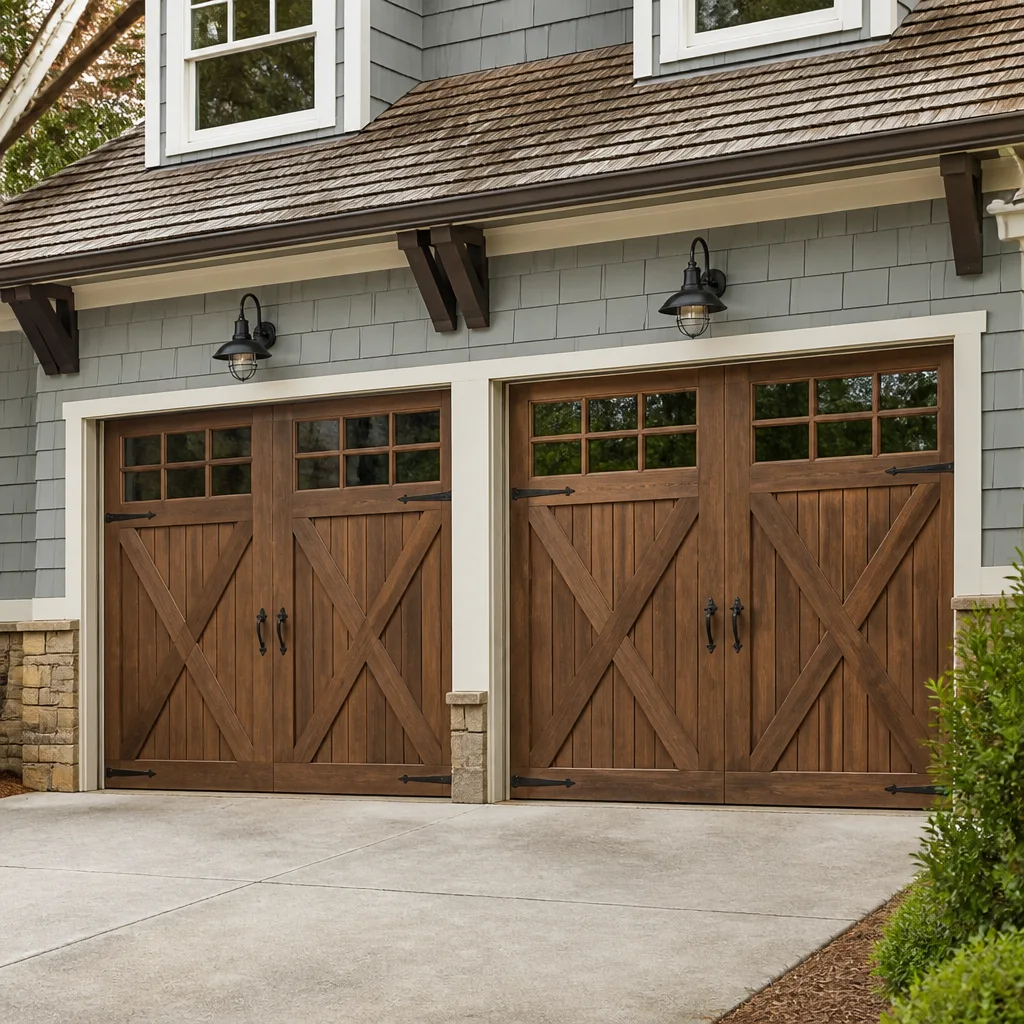 Carriage house
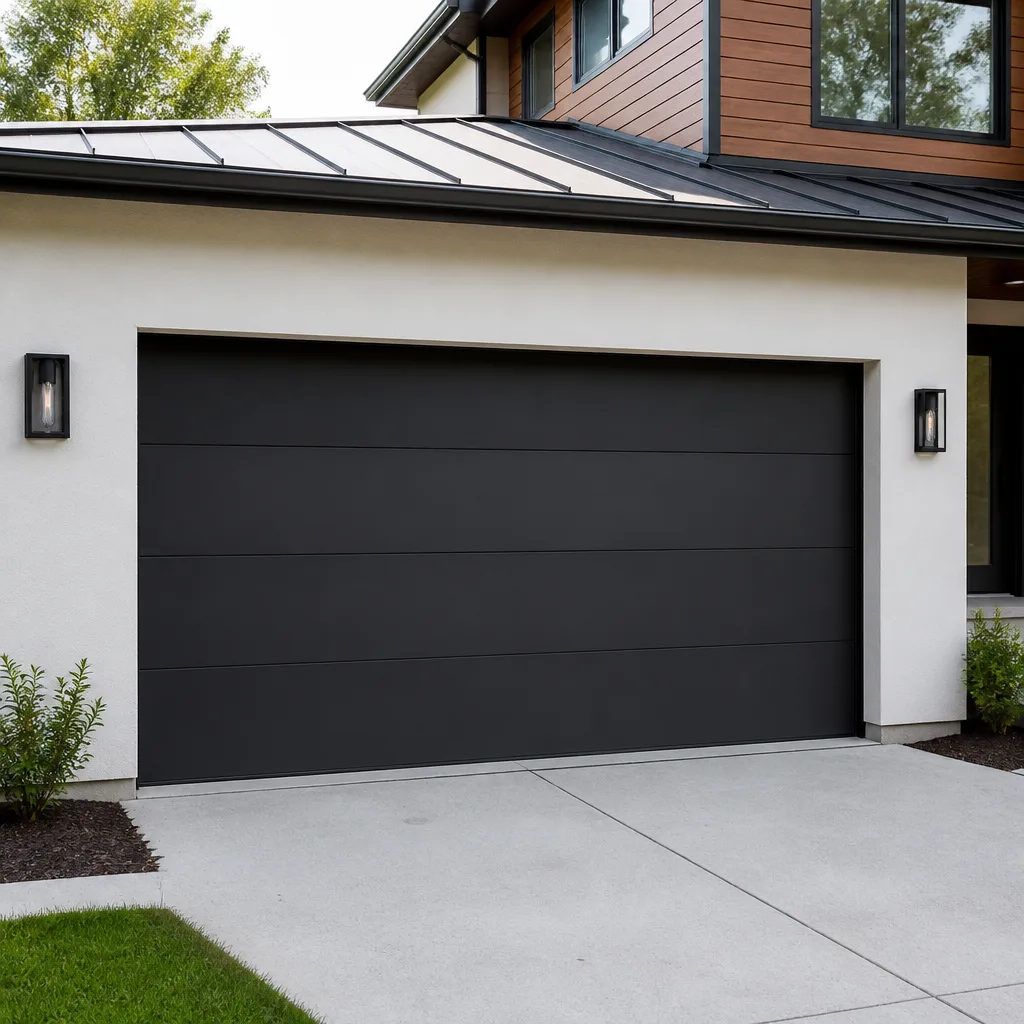 Modern flush
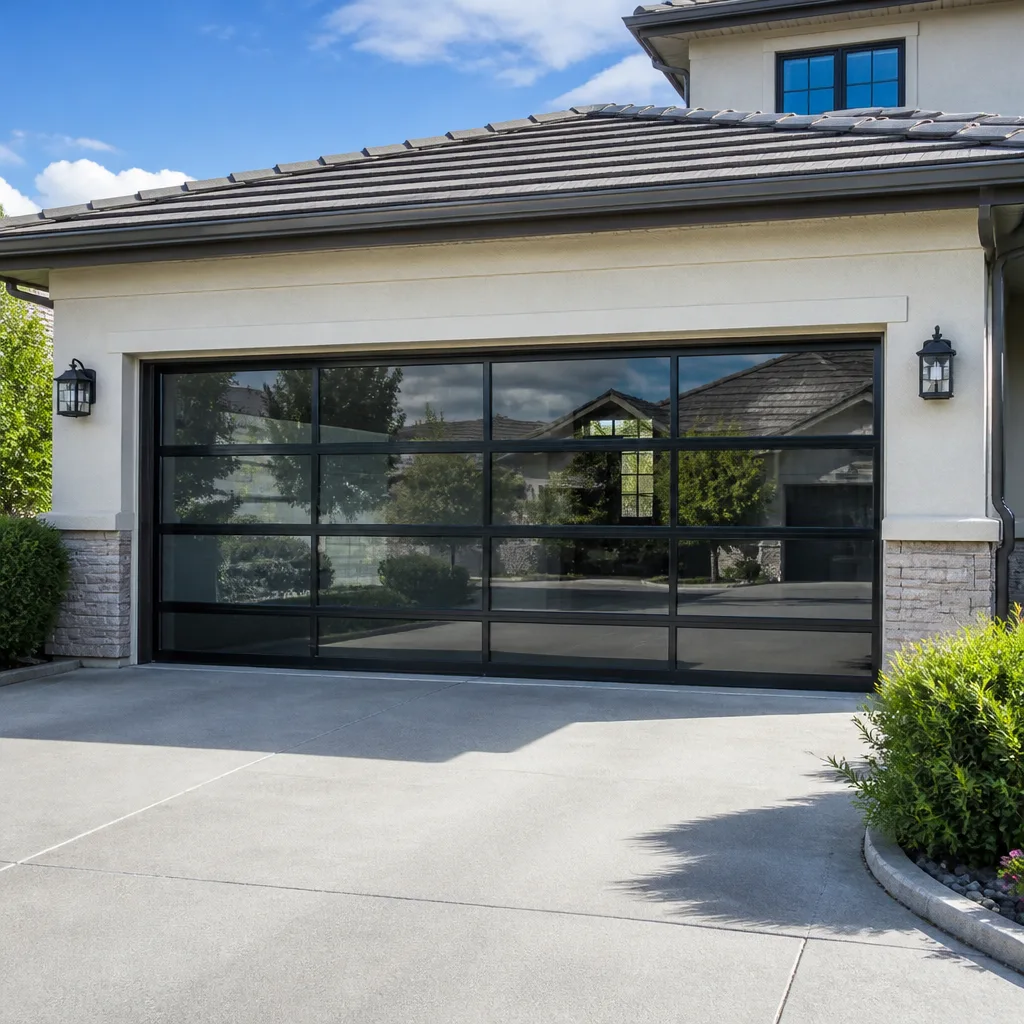 Full-view glass
 LiftMaster openers
 Chamberlain openers
Full 25-point door and opener safety check with every visit - springs, cables, rollers, tracks, and your LiftMaster or Chamberlain opener included
You get a price before we start. It does not change when the truck arrives.
Get your free estimateGarage Door Warning Signs: A Las Vegas Homeowner’s Reference Guide
Most garage door guides read like a grocery list of symptoms with no triage. That’s the problem. A frayed cable and a dirty photo eye are both “warning signs,” but one can kill you and the other needs a rag. In Las Vegas, where a garage door can easily cycle five or six times a day and sit baking in 110-degree heat for months on end, knowing which sign means “stop using this door tonight” versus “add it to the spring tune-up list” is the difference between a $120 roller replacement and a $2,400 full system rebuild. This guide will teach you that distinction, show you how to spot Las Vegas-specific failures that national guides ignore, and give you the exact language to describe what you’re seeing so a technician arrives with the right parts on the first trip. For a broader overview, see our The Complete Guide to Garage Door in Las Vegas.
Quick Answer
The most serious garage door warning signs in Las Vegas are a visible gap in a torsion spring coil, fraying cables at the drum, a door that falls faster than normal when closing manually, or a loud pop followed by the door refusing to lift. Any of these means stop using the door immediately and call a professional. Less urgent signs like slow operation in morning cool, a grinding sound during travel, or white mineral crust on the bottom seal can usually wait a few days to a week, but should still be addressed before they cascade into a bigger failure. Our Seasonal Garage Door Care for Las Vegas: Year-Round Homeowner’s Guide explains when to schedule these repairs.
Styles & brands we work with
Table of Contents
- Warning Sign Urgency Classification: Stop Now, This Week, or Monitor
- Las Vegas-Specific Warning Signs Most Guides Miss
- Sound Diagnostics: Grinding vs. Popping vs. Rattling
- Visual Inspection Points You Can Check From the Ground
- How to Describe a Warning Sign to a Technician
- Las Vegas Seasonal Failure Patterns and What They Mean
- What Common Warning Sign Repairs Cost in Las Vegas
- Common Mistakes to Avoid
- When to Call a Professional
- Frequently Asked Questions
Warning Sign Urgency Classification: Stop Now, This Week, or Monitor
Every garage door symptom falls into one of three buckets. Misclassifying a symptom is dangerous in both directions: ignoring a spring failure can drop a 200-pound door on a car or a person, while calling for emergency service on a chirping opener wastes your money and a technician’s time. Here’s how we triage every sign we hear about on the phone, and it’s the same framework we use when we arrive at your door in Las Vegas.
Category 1: Stop Using the Door Now
These signs mean a component carrying the door’s full weight has failed or is about to. Continuing to operate the door, even once, can cause a free-fall or a cascade failure that triples the repair cost. In our experience serving Las Vegas since 2001, a homeowner who stops at the first sign of a spring problem usually pays $180 to $340. One who keeps pressing the button often ends up at $800 to $1,200 with a damaged opener on top of the spring.
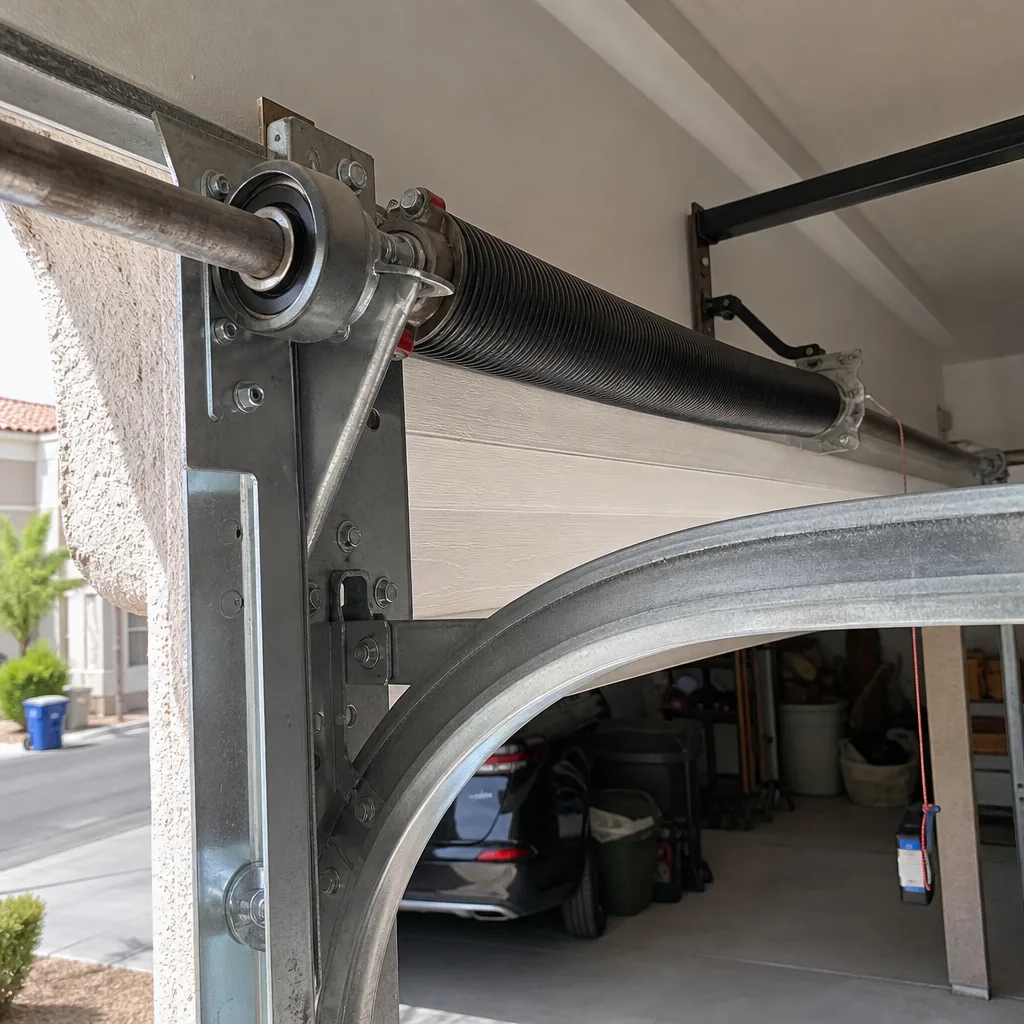
- Visible gap in a torsion spring coil: Torsion springs, the large coils mounted above the door on a horizontal shaft, are wound tight with enough tension to lift the door’s weight. If you see a gap where the coil has separated into two pieces, that spring has snapped. The door now has roughly half the lifting force it needs. The opener’s trolley carriage, the metal bracket that travels along the rail and pulls the door, is now taking the other half. It was never designed for that load.
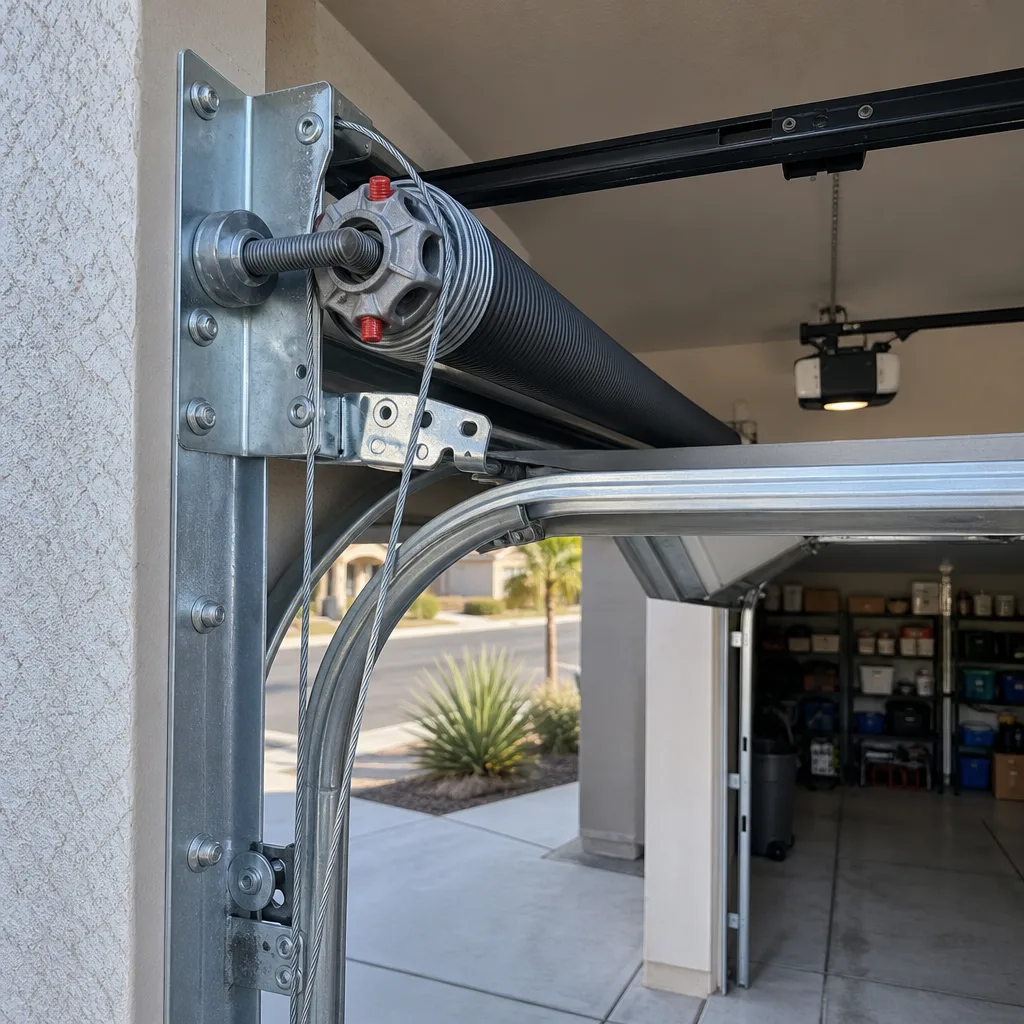
- Frayed cable strands at the drum: The lift cables are steel cables that wind around a drum at each end of the torsion shaft. If you see individual strands poking out or a fuzzy-looking section near the drum, the cable is unraveling under tension. When that cable finally lets go, the door can drop violently on that side, twisting the entire door in its tracks.
- Door falls faster than normal when closing manually: If you pull the red release handle and the door drops like it’s in a hurry, the springs are not counterbalancing the weight. A properly balanced door should stay roughly where you leave it, drifting only slightly. A fast drop means spring failure is imminent even if you can’t see a gap yet.
- Loud pop followed by door refusing to lift: That pop is the sound of a torsion spring snapping under tension. It is frequently described as sounding like a gunshot from inside the garage. After the pop, the opener will strain against the full weight of the door and usually trip its internal overload or strip the carriage.
Category 2: Schedule Within the Week
These signs mean a component is wearing out but is not yet at failure point. The door is safe to use for a few more days if you’re careful, but the underlying issue is getting worse with every cycle. In Las Vegas heat, some of these deteriorate faster than they would in cooler climates.
- Grinding or squealing sound during travel: This typically means worn roller bearings or dry rollers. The rollers are the small wheels that ride inside the vertical and horizontal tracks. When their internal bearings wear out, the roller stops spinning freely and starts sliding against the track, causing metal-on-metal grinding. Left alone, the rollers can seize entirely and gouge the tracks.
- Door hesitates or stutters on the way up: A door that lurches, pauses, or reverses mid-travel often points to a failing opener gear or an unbalanced door that’s fighting the opener. The sprocket and gear inside a LiftMaster or Chamberlain opener are plastic by design, intended to be the sacrificial part. When they start stripping, the door jerks as the gear teeth skip.
- Door slowly creeps down after being opened: If the door won’t hold position at the top and settles a few inches, the springs are losing tension or the opener’s limit switch, the internal setting that tells the opener where “up” is, has drifted. Either way, the door is not stable at the top of its travel.
- Opener runs longer than it used to: In Las Vegas summer, this is often heat-related torque loss, which we cover in detail below. But it can also mean the opener is working harder against worn springs, and that added strain shortens the opener’s motor life significantly.
Category 3: Monitor and Mention at Next Service
These signs are mild annoyances or early warnings that don’t require an immediate visit. Note them, watch for changes, and mention them next time a technician is out for maintenance or another repair. None of these will cause a failure on their own, but they’re useful diagnostic clues.
- White mineral deposits on the bottom seal: This is caliche, the mineral-laden hard water common across the Las Vegas Valley. It crusts onto the rubber bottom seal and eventually stiffens it, reducing the seal’s ability to flex and block dust and heat. It’s a cosmetic and efficiency issue, not a safety one.
- Slight rattling when the door moves: A mild rattle without any grinding usually means a loose bolt on the trolley carriage or the hinge brackets. It’s worth tightening at the next service, but a few loose bolts are not a structural emergency.
- Faint chirping from the opener unit: Many openers, including Genie and Chamberlain models, chirp periodically to signal a battery backup that needs replacing or a sensor misalignment. It’s designed to be annoying enough that you eventually deal with it.
- Weatherstripping pulling away from the frame: The side and top weatherstripping on a Las Vegas garage door takes a beating from UV exposure and the extreme expansion and contraction cycle. When it starts peeling back, the garage loses cooling efficiency and lets dust in, but the door itself is still safe to operate.
Las Vegas-Specific Warning Signs Most Guides Miss
National garage door guides are written for national averages. They don’t account for the fact that Las Vegas sees 300-plus days of sunshine a year, summer highs that routinely cross 110 degrees, and a winter-to-summer temperature swing of more than 60 degrees inside an uninsulated garage. That climate produces failure patterns you won’t find in a guide written for Cleveland or Seattle. Here’s what we see on service calls in Summerlin, Henderson, and North Las Vegas that a generic list will never mention.
Door Hesitation in Morning vs. Afternoon: Thermal Expansion of Metal Tracks
If your door stutters or binds in the early morning but operates smoothly by afternoon, and then the pattern reverses as the seasons shift, you’re seeing thermal expansion in action. The steel tracks that guide your door expand and contract with temperature. In a Las Vegas garage that drops to 45 degrees on a January night and hits 120 in an August afternoon, that expansion is measurable. A track that was installed slightly too tight, or a door that was adjusted at the wrong time of day, will bind at one end of that thermal cycle. The fix is usually a track adjustment, not a new opener, which is why we always ask what time of day the problem shows up before we dispatch a technician.
Opener Running Longer Than Usual in Summer: Heat-Related Torque Loss
Torsion springs lose tension as ambient temperature rises. This is a physical property of the spring steel, not a defect. In a Las Vegas summer garage that sits at 110 to 125 degrees for hours, a spring that was perfectly balanced in spring can lose enough tension that the opener has to work noticeably harder and run longer to lift the same door. The danger is that the opener’s motor and plastic drive gear, which are also running hot, now have to work against a heavier door. We’ve replaced too many opener gears in July and August because a homeowner assumed the slow operation was normal summer behavior and never got the springs re-tensioned. If your door was fast in May and slow in August, that’s not normal. That’s a heat-tension failure waiting to become an opener failure.
White Mineral Deposits on Bottom Seal: Caliche Water Damage
Las Vegas tap water is famously hard. That hardness comes from dissolved minerals, primarily calcium carbonate, that precipitate out as water evaporates. When irrigation overspray, a car wash, or monsoon rain pools against your garage door bottom seal and evaporates in the desert air, it leaves behind a white, chalky crust we call caliche. Over months, that crust stiffens the rubber, causing it to crack and lose its seal. A cracked bottom seal lets in dust, heat, and scorpions. The fix is a simple seal replacement, but if your garage faces a lawn area or you hand-wash cars in the driveway, you’ll want a seal made from a stiffer rubber compound that resists caliche buildup better than the standard vinyl.
Sun-Baked Opener Logic Boards
Most opener failures in Las Vegas are not mechanical. They’re electronic. The logic board inside a Genie, LiftMaster, or Chamberlain opener sits inside a metal housing that absorbs heat all day long. Logic boards have a thermal limit, and in a Las Vegas garage that regularly hits 120 degrees, that limit gets tested daily, especially on openers mounted on west-facing walls that catch afternoon sun. The warning sign is usually intermittent: the opener works fine in the morning, refuses to respond in the afternoon, and works again after sundown. If that pattern sounds familiar, the logic board is overheating, and the eventual failure will be permanent.
Sound Diagnostics: Grinding vs. Popping vs. Rattling
A garage door makes three types of sounds that mean three completely different things. Learning the difference will help you describe the problem accurately over the phone, and it will help you know how urgently to act. Here is the sound, the trade term, and the plain-English explanation for each.
Grinding: Worn Roller Bearings
What you hear: A rough, scraping, metal-on-metal sound that follows the door as it travels, usually louder on one side than the other.
What it means: The rollers, which are the small wheels mounted on the door’s hinge brackets, spin on internal ball bearings. When those bearings wear out, usually due to heat and dust intrusion, the roller stops spinning freely. The wheel now slides against the track instead of rolling, and that friction sounds like grinding. If you’ve ever heard a shopping cart with a locked wheel being pushed across a parking lot, you know the sound.
What to do: Schedule within the week, and stop using the door in the meantime if the grinding intensifies. The rollers are coming apart internally, and when one seizes completely, the door will bind and the opener will strain against it. Roller replacement is one of the most common repairs we do in Las Vegas, and the fix is straightforward.
Popping: Coil Binding on a Torsion Spring
What you hear: A sharp, periodic pop or crack that happens as the door moves, usually at a specific point in the travel.
What it means: The torsion spring, the large coil mounted above the door, is binding against itself or against the center bearing plate. As the spring winds and unwinds under tension, a section of the coil is catching and releasing. This matters because a spring that is binding is not distributing its load evenly, and uneven load on a torsion spring is a precursor to fatigue failure.
What to do: This is a Category 1.5 situation. A binding spring means the spring is under uneven stress, and that stress is concentrated on a single point of the coil. We’ve seen binding springs fail within days of the first pop. Call a professional immediately. Do not continue cycling the door to see if the sound goes away.
Rattling: Loose Trolley Carriage Bolt
What you hear: A light, rattling, or chattering sound that seems to come from above the center of the door, near the opener rail.
What it means: The trolley carriage, the metal bracket that connects the door to the opener’s chain or belt and travels along the rail, is held together by bolts and pins. Over years of vibration, those fasteners work loose. The rattling is the sound of loose metal parts vibrating against each other as the carriage travels.
What to do: Monitor and mention at next service. A loose carriage bolt is not an emergency, but it should be tightened before the slack allows the carriage to wobble and accelerate wear on the rail. If the rattle turns into a clunk, move it up to the schedule-this-week category, because the bolt is now loose enough that the carriage is moving in ways it shouldn’t.
Visual Inspection Points You Can Check From the Ground
You don’t need a ladder, and you don’t need to touch anything. In fact, the most important rule for this section is: never touch any component under tension. Torsion springs carry hundreds of pounds of torque, and the cables that run alongside the door are under enough tension to sever fingers. The inspection points below are all visible from standing height, and none of them require you to disassemble anything. This is a “look, don’t touch” checklist. If you see any of these signs, call a professional who is trained to work around that stored energy safely.
Check 1: The Torsion Spring Gap
Stand inside the garage, about six feet back from the door, and look up at the horizontal shaft above the door opening. There are one or two large coils mounted on that shaft. Look for a gap in the coil, a visible separation where the continuous spiral seems to be split into two pieces. That gap is where a spring snapped. If you have two springs and one is in two pieces, the remaining spring is now carrying the full weight, and it will fail soon under the doubled load.
Check 2: The Cable at the Drum
Look at the upper corners of the door, where the horizontal shaft meets the vertical tracks. At each end, you’ll see a round drum with a steel cable wound around it. That cable runs down the side of the door and anchors at the bottom corner bracket. Look for any individual wire strands poking out from the cable, any section that looks fuzzy or frayed, or any gap between the cable and the drum. Any of those means the cable is failing under tension.
Check 3: The Roller and Bracket Condition
Follow the line where the door meets the vertical tracks on both sides. At each hinge point, you’ll see a roller wheel. Look for rollers that are visibly worn, missing a chunk of material, or not sitting straight in the track. Also look at the bottom roller brackets, the metal fixtures that hold the bottom rollers in place. In Las Vegas, these brackets are prone to rust bloom, that orange-brown powdery corrosion that forms on metal exposed to humidity and hard-water overspray. A rusted bottom bracket is a bracket that will eventually crack.
Check 4: The Track Alignment
Stare down the length of each vertical track from the front. The track should run straight up and curve cleanly into the horizontal section. If you can see a bow, a kink, or a visible gap between the track and the wall where the track has pulled away, the door is operating out of alignment. Misaligned tracks put uneven load on every other component, and they’re frequently the root cause of the other symptoms on this list.
Check 5: The Bottom Seal Condition
Look at the very bottom edge of the door from the outside. The rubber or vinyl seal should run continuously across the width of the door with no gaps, cracks, or hard white crust. If the seal is cracked, separated from the door, or caked with caliche, it’s no longer doing its job of keeping heat, dust, and pests out of the garage. In a Las Vegas summer, a failed bottom seal can raise garage interior temperature by 10 to 15 degrees.
How to Describe a Warning Sign to a Technician
The single most useful thing you can do before calling a garage door company is to gather the right information and describe it in the language a technician can act on. A good phone description means the tech arrives with the right parts on the truck, saving you a second-trip fee and several days of waiting. Here’s how to structure the conversation when you call.
Step 1: State the Primary Symptom in One Sentence
Don’t lead with a diagnosis. Lead with what you observed. Say “I saw a gap in the spring above the door” rather than “I think I need a new spring.” Say “The door grinds when it goes up, louder on the left side” rather than “the rollers are bad.” The tech will form the diagnosis. Your job is accurate observation.
Step 2: Describe the Sound, Not Your Interpretation of It
Use the sound vocabulary from this guide. “It’s a grinding sound” means something specific. “It’s a popping sound” means something else. If you’re not sure which word applies, describe what it sounds like in everyday terms. “It sounds like shopping cart wheels on gravel” is more useful than “it sounds weird.”
Step 3: Note When the Problem Occurs
This matters more in Las Vegas than almost anywhere else. Tell the technician if the problem only happens in the morning, only in the afternoon, or only when the garage has been in the sun all day. That timing information is diagnostic. A technician who knows the door only binds when it’s cold is going to look at track alignment first, and that focus might save you a misdiagnosed opener replacement.
Step 4: Report What You Checked Visually
Run through the visual inspection checklist above and report anything you saw. Even “the cables look fine” is useful information. “I saw fraying on the left cable near the top drum” is the single most valuable sentence you can say on that phone call, because it tells the tech exactly what to bring and exactly what to check first.
When you call us at (725) 224-5155, the person who answers is a trained dispatcher who knows which questions to ask and how to translate your description into a repair plan. The tech who shows up at your door will already know what you described, and thanks to the Threshold Standard, you’ll already know their name and see their photo before they arrive.
Las Vegas Seasonal Failure Patterns and What They Mean
Garage doors in Las Vegas fail on a seasonal calendar, and once you know the calendar, you can anticipate problems before they strand you. Here’s what we see each year, based on two decades of service calls across the Valley.
Summer: Springs, Logic Boards, and Opener Gears
June through September is our busiest season for torsion spring failures and opener motor burnouts. The twin stressors are heat and usage. Kids are home from school, which means the door cycles more often. The garage interior temperature is 110 to 125 degrees, which saps spring tension and overheats opener electronics. Every summer we replace dozens of opener gears that stripped because a spring lost tension and the motor was forced to work against a heavier door in the worst possible conditions. The warning sign is almost always “the door is running slower than it used to,” and almost always it’s too late for the gear by the time we’re called.
Monsoon Season: Track Corrosion and Humidity Swelling
Late summer brings the monsoon, and with it, a spike in humidity that Las Vegas door components are not built for. Metal tracks that have been bone-dry all year suddenly get condensation. If there’s any bare metal exposed, that’s where the rust starts. The bottom roller brackets, which take the brunt of splash-back from the driveway, are the usual victims. We also see wooden door frames swell with humidity and bind against the door edges, where the door scrapes on one side only during humid weeks. If your door sticks only after a rain, that’s frame swelling, and it’s usually fixed by realigning the tracks to accommodate the movement.
Winter: Morning Binding and Limit Switch Drift
Cold mornings in January and February, when garage temperatures drop into the 40s, bring out the morning binding we described earlier. Metal tracks contract, hinges tighten up, and a door that was balanced for 80-degree weather suddenly binds on the way up. This is also the season for limit switch drift. The limit switch, the internal setting inside the opener that tells it where the “down” position is, can drift over time. In winter, when the door is at its most contracted, the switch setting may no longer match the door’s actual position, causing the door to reverse after touching the ground or stop short of the floor.
Spring: The Season of Neglect
Spring is the least severe season for garage door failures, largely because the weather is mild. But spring is also when we see the accumulated damage of a year of neglect surface. A spring that lost tension over the summer was kept running through fall and winter by an opener working harder than it should. By spring, that opener has reached its limit, and we get the call for a door that won’t open at all. The failure happened in August. The symptom shows up in March. That’s why we recommend a spring tune-up every spring in Las Vegas, before the heat cycle starts again. For additional maintenance tips, check out our more guides & resources.
What Common Warning Sign Repairs Cost in Las Vegas
Knowing the ballpark cost before you call removes the anxiety from the conversation. These are the price ranges we’ve seen consistently in the Las Vegas market for 2025 and early 2026, and they reflect the reality that the cost of a component is small compared to the cost of the labor and the expertise required to work safely around stored spring tension. Every price below includes the part and the installation labor, and as always, we put the exact price in writing before any work starts.
Repair Cost Ranges
- Torsion spring replacement (one spring): $180 to $340
- Torsion spring replacement (both springs, recommended): $320 to $550
- Lift cable replacement (one side): $140 to $230
- Roller replacement (full set of 10-12 rollers): $150 to $250
- Bottom seal replacement: $90 to $170
- Opener logic board replacement: $160 to $300
- Opener gear and sprocket replacement: $170 to $280
- Track realignment: $130 to $220
- Full opener installation (new unit, LiftMaster or Genie): $480 to $820
These are Las Vegas market ranges, not national averages. Costs vary based on door weight, spring size, and whether your opener is compatible with the replacement parts. The ranges above assume a standard 7-foot-high, 16-foot-wide steel door, typical of most Las Vegas homes built since 1995. Taller doors, older wooden doors, or doors with non-standard spring dimensions will run higher.
Two notes worth making explicit. First, spring replacement on a two-spring door is usually done as a pair. When one spring breaks, the other is typically at the same fatigue point, and replacing only one usually means paying for a second visit within a year. Second, the price you’re quoted before the work starts is the price you pay when the work is done. Every job with Doyle Garage Doors Las Vegas includes a written price before a single bolt is turned, so there are no invoice surprises at the end.
Common Mistakes to Avoid
- Continuing to use the door after a spring snaps. When one torsion spring breaks, the door still moves, driven by the remaining spring and the opener. Every cycle you run after the break adds stress to the remaining spring and the opener gear. The second spring almost always breaks within weeks, and by then the opener is damaged too. Stop using the door the moment you see the gap.
- Assuming a loud pop was “just the neighbor’s car.” A snapping torsion spring sounds exactly like a gunshot or a car backfiring, and the sound travels. If you hear a sharp bang from the garage area and the door won’t operate, check the spring before assuming anything else.
- Attempting to re-tension or replace a spring themselves. Torsion springs carry enough stored energy to break bones or kill. The tools used to wind them are specially designed for the job, and the procedure requires exact knowledge of the spring’s wire size, diameter, and winding direction. This is not a YouTube weekend project. This is one of the few home components where a mistake can be fatal.
- Adding grease to a noisy door without addressing the cause. A squirt of lubricant quiets a grinding roller for a few days and then the grinding returns, worse, because the grease has now attracted dust and turned into an abrasive paste. Lubrication is part of normal maintenance, but it doesn’t fix a worn bearing.
- Manually disengaging the emergency release handle while the door is under load. The red release handle is designed to disconnect the opener in an emergency, but pulling it while the door is partially open and under tension can cause the door to slam down. If the spring is broken, the door is not in balance, and a slam is likely. Only disengage the release when the door is fully closed.
- Waiting out a symptom because “it’s been doing that for months.” Garage door components fail progressively. A door that has been grinding for three months has been wearing out its tracks for three months. What could have been a $180 roller replacement can turn into a $600 track and roller job if the grinding wears a groove into the track.
- Replacing the opener before checking the springs. In Las Vegas summer, homeowners often assume a slow, struggling door means the opener motor is dying, when the real problem is loss of spring tension from heat. A new opener won’t fix an under-sprung door, and the new opener will burn out just as fast. Check the springs before paying for a new opener.
When to Call a Professional
Call a professional the moment you see any Category 1 sign: a visible spring gap, fraying cable, a door that drops when released, or a loud pop followed by failure. These are not conditions that improve with time, and the risk of continuing to operate the door is real and physical. For Category 2 signs, schedule within the week before wear cascades. For Category 3 signs, note them and mention them at your next tune-up. If you’re in Las Vegas and not sure which category your symptom falls into, call (725) 224-5155 and describe what you’re seeing. A live person answers day, night, weekend, and holiday, and we’ll help you determine urgency over the phone before anyone schedules a visit. We offer free estimates across Las Vegas, Henderson, and North Las Vegas, and every visit includes the price in writing before work begins.
Frequently Asked Questions
A standard torsion spring on a Las Vegas garage door lasts 7 to 10 years, or roughly 10,000 to 15,000 cycles. That lifespan is shorter than the national average of 10 to 12 years because Las Vegas heat accelerates spring fatigue. If your door cycles four to six times a day, which is common for families with multiple drivers, that 10,000-cycle rating translates to about 6 to 9 years. If your home is approaching that age and the springs have never been replaced, consider a proactive inspection. Call (725) 224-5155 for a free spring assessment, or learn more about our Garage Door Repair in Las Vegas services.
Cold-weather-only noise usually points to thermal contraction of the metal tracks. As the steel track shrinks in cold temperatures, the clearance between the rollers and the track decreases, and any minor misalignment becomes a scraping or binding sound. In Las Vegas, this shows up on January and February mornings when garage temperatures drop into the 40s. It’s usually a sign that the tracks were adjusted in warm weather and need slight seasonal realignment. The fix is minor, but ignoring it can accelerate roller wear.
No. The lift cables on a garage door are under constant tension from the torsion springs, and the cable path runs through pulleys and drums that amplify that force. A cable that snaps during a DIY attempt can whip across the garage with enough force to cause serious injury. Even removing the old cable requires first releasing the spring tension, which itself requires special tools and training. This is a job for a professional, and the $140 to $230 cost of cable replacement is a fraction of what an injury costs.
Morning-only or afternoon-only operation is a classic sign of thermal expansion affecting your tracks or your opener’s electrical components. If the door operates in the cool morning but stops working in the hot afternoon, the likely culprit is either a track that expands in the heat and binds, or a logic board that overheats and shuts down. If the failure only happens on the hottest days, and the door works again after sunset, you’re probably looking at heat-related electronic failure in the opener, and the logic board will eventually fail permanently.
Not at Doyle Garage Doors Las Vegas. The price quoted before work begins is the price you pay, period. We put every quote in writing before a single bolt is turned, and that written quote is binding. In the rare case that we discover additional damage during the repair that wasn’t visible at the initial assessment, we stop work, show you what we found, and get your written approval for any change before we continue. There are no surprise invoices. This is part of the no-hassle upfront pricing commitment that applies to every job, including every Garage Door Opener Repair in Las Vegas we perform.
For common failures like torsion springs, lift cables, rollers, and bottom seals, our technicians carry the most frequently needed sizes on the truck. Most repairs are completed in one visit. For less common parts, like a specific brand of opener logic board or a non-standard door panel, we may need a follow-up visit. That’s also why describing your warning sign accurately on the phone matters so much. The more detail the dispatcher gets, the better matched the truck inventory will be. If you’re considering a new door or a major system upgrade, see our Garage Door Installation in Las Vegas page for what to expect.
The Bottom Line
Your garage door is the largest moving object in your home, and in Las Vegas, it’s also the one under the most environmental stress. Heat fatigues springs, thermal expansion shifts tracks, and hard water corrodes seals. The warning signs your door gives you, whether it’s a gap in a coil, a grinding sound, or a slow afternoon crawl, are specific messages about specific components. Learn to read them, act on the urgent ones immediately, and you’ll avoid the failure cascade that turns a $200 spring replacement into a $1,200 system rebuild. When a sign does appear, call (725) 224-5155. A live person answers, a named and photo-verified technician shows up, and the price is in writing before work starts, every time.
Written by Aaron Teague, Owner at Doyle Garage Doors Las Vegas, serving Las Vegas since 2001.
See the difference
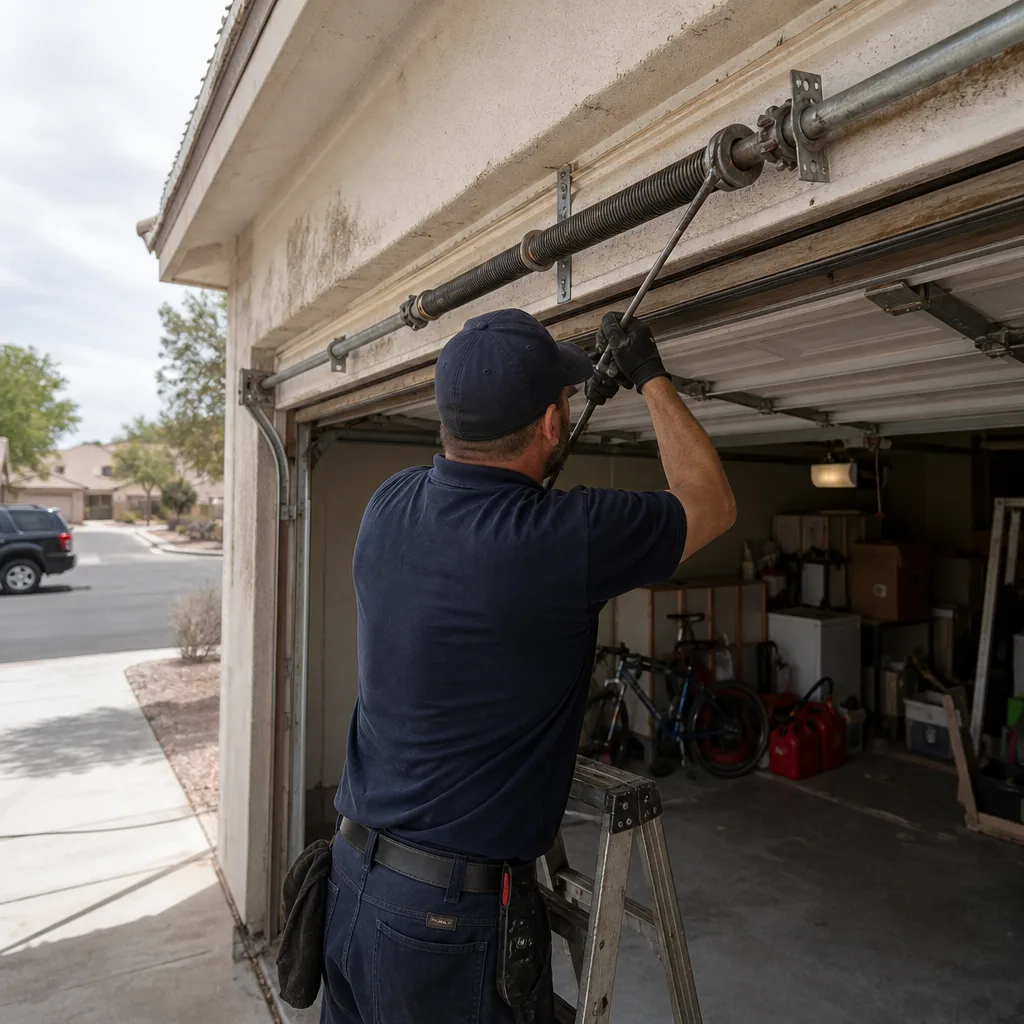 Before
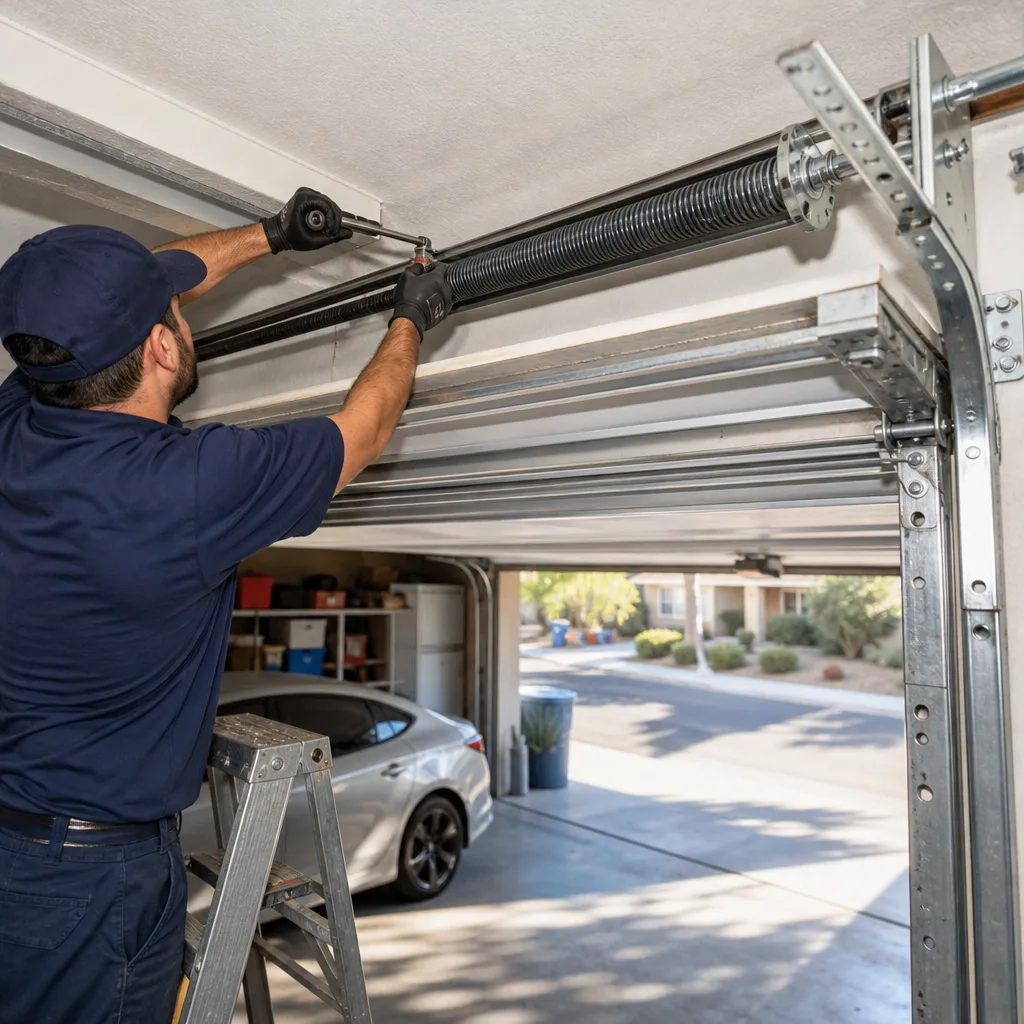 After
After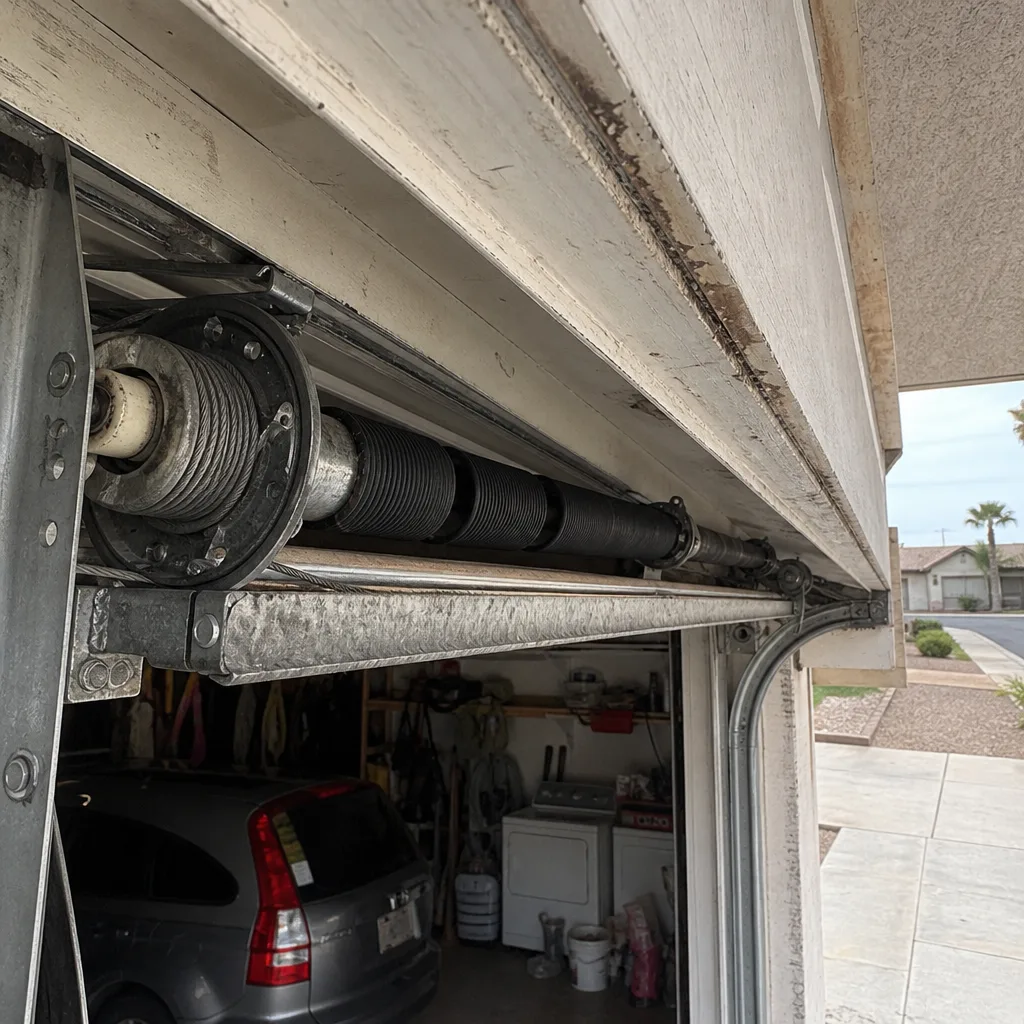 Before
 After
After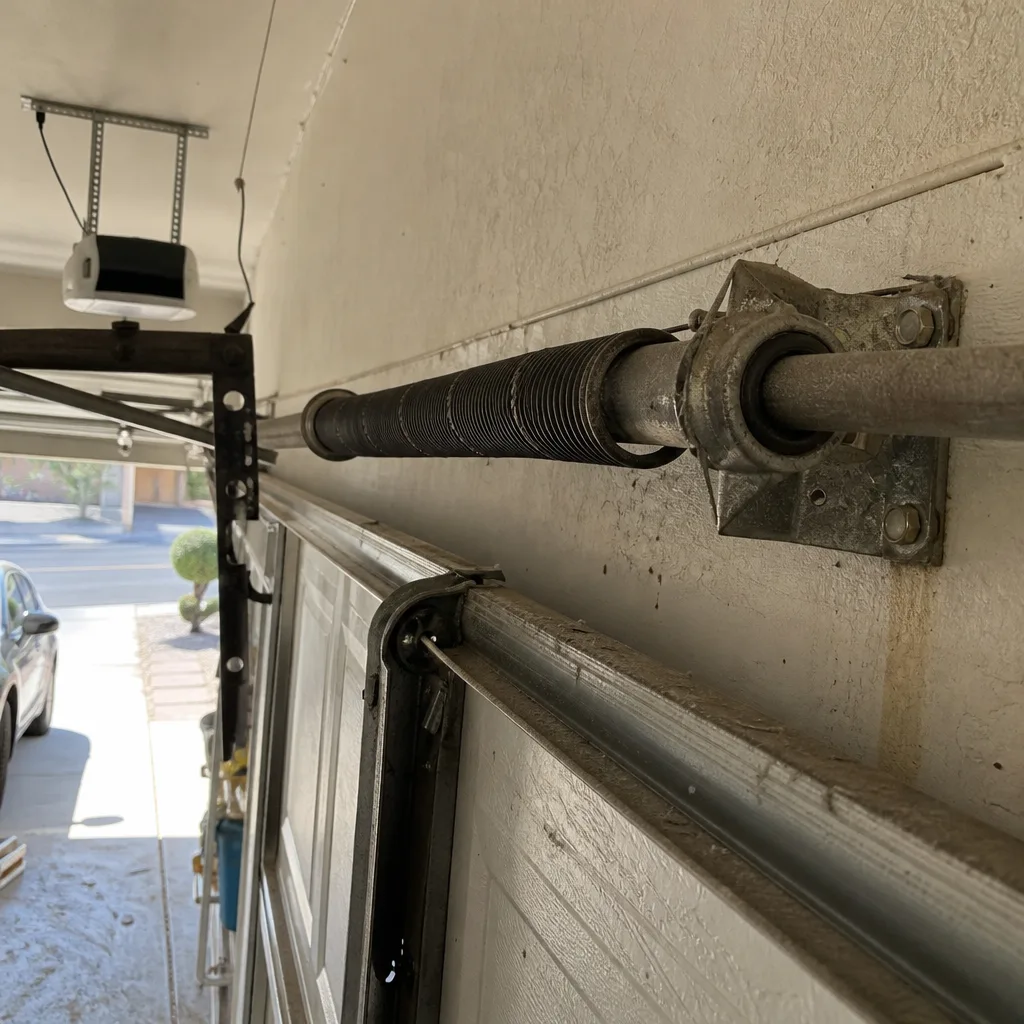 Before
 After
After